Interior Drain Tile & Sump Systems
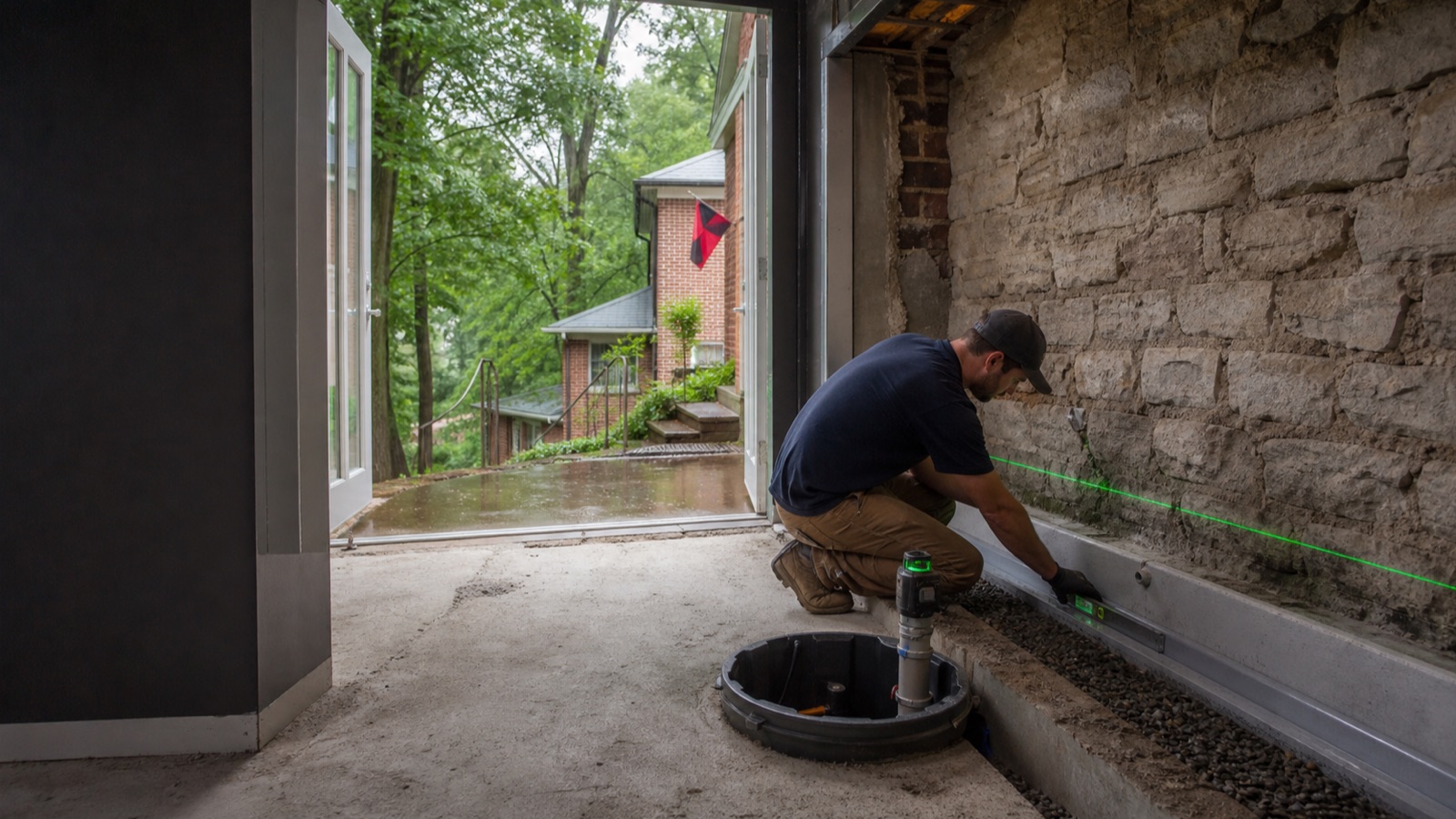
Sub-floor perimeter French drain routed to a sump basin. The workhorse fix for hydrostatic seepage.
Typical$3,500 to $8,000
Basement waterproofing across Greater Cincinnati and Northern Kentucky since 2017, performed by licensed, insured local contractors. Interior drainage, sump systems, crack injection, and exterior membrane, scoped to your home and your clay-soil water problem. On-site assessment with a fixed-price quote.
Step 1
Tell us where the water shows up and when. 10-minute call, no pressure, plain answers about what is likely driving it.
Step 2
The Cincinnati-area technician finds where water actually enters, identifies the right fix for your soil and foundation, and gives a fixed quote on the same visit.
Step 3
Most interior drainage systems install in 1 to 2 days. The crew sets the drain tile, sump, and wall membrane, and pours the slab back flush.
Step 4
Every interior system ships with a written warranty against seepage in the protected area, transferable to the next owner, plus a compliant discharge built to MSDGC or SD1 rules.
of US homes have some basement moisture, and Cincinnati clay soils put the region at the high end of that range.
Source: Basement Health Association
typical Cincinnati cost for a complete interior drainage and sump system, the most common permanent fix.
Typical range across Greater Cincinnati installs since 2017
Sump pumps may not discharge into the sanitary sewer in Greater Cincinnati. MSDGC requires a storm-appropriate discharge.
Water is the leading cause of foundation failure. Controlling it protects the structure, not just the finishes.
Consensus across Greater Cincinnati foundation and waterproofing work
The key to mold control is moisture control: fix the water problem, and dry wet areas within 24 to 48 hours.
Sump pumps and foundation drains may not discharge into the sanitary sewer; combined-sewer neighborhoods have backwater-valve and basement-protection programs.
Interior perimeter drainage to a sump is an established method for managing hydrostatic seepage in below-grade spaces.
Home inspectors evaluate basement moisture, efflorescence, sump function, and egress windows; documented waterproofing supports the disclosure record.
On the Northern Kentucky side, SD1 administers the stormwater and sanitary rules that govern sump discharge in Boone, Kenton, and Campbell counties.
Every job comes with a written quote and no-pressure consultation. Workmanship warranty terms are set by your lead technician and confirmed before work begins.
Sub-floor perimeter French drain routed to a sump basin. The workhorse fix for hydrostatic seepage.
New sump installs, pump replacement, and battery or water-powered backup so the basement stays dry when the power fails.
Polyurethane and epoxy crack injection that seals poured-wall seepage from the inside, no excavation.
The dig-out solution: excavate to the footer, apply exterior membrane, and install a new footer drain.
Sealed vapor barrier plus dehumidifier to lock out ground moisture and humidity in crawl spaces and basements.
Egress window installs plus window-well drainage to stop the well from filling and flooding the basement.
We offer $100 off any basement waterproofing project for veterans, active military, first responders, and seniors 65 and older. Mention it when you call or request your assessment.
Mention this offer when you call
(513) 966-5325“We found water along the basement wall two weeks before listing and panicked. CWP came out the next day, diagnosed it as a full-perimeter issue, and had a drainage system in and documented before our photos. The buyer inspection was a non-event.”
“Our hillside basement only leaked on the uphill wall. Two other companies quoted a full exterior dig-out. The CWP contractor explained it was lateral pressure and did interior drainage on the affected wall plus a curtain drain uphill, for half the price. Dry through two wet springs now.”
“Newer house, one crack in the poured wall that leaked every storm. They diagnosed it as a single-source crack, injected it in an afternoon for a few hundred dollars, and did not try to upsell me a whole drainage system. Honest and fast.”
These reflect real situations from homeowners across our network. Names and some identifying details are adjusted to protect homeowner privacy while keeping the point of each story intact.
Greater Cincinnati sits on heavy lacustrine and glacial-till clay soils, and clay is the worst soil there is for keeping a basement dry. Where sandy soil lets rainwater drain away from a foundation, clay holds water against the wall and swells as it absorbs, building hydrostatic pressure that pushes moisture through the cove joint, through wall cracks, through block cores and stone-mortar joints, and even through porous concrete itself. After a multi-day soaker (the kind Cincinnati gets every spring) the water table in many neighborhoods rises high enough to put the footer underwater. That is the moment basements take on water, and it is the moment an interior drainage system is built for.
Geography compounds the soil. The Mill Creek valley and the Ohio River bottoms keep the seasonal water table high in lower-lying parts of Northside, Lower Price Hill, Sayler Park, and the Kentucky river towns of Bellevue and Dayton. Hillside neighborhoods like Mt. Adams, Mt. Lookout, Columbia Tusculum, and the Hyde Park slopes get the opposite problem: groundwater sheets downhill and hits the uphill foundation wall under lateral pressure. Freeze-thaw cycling through a Cincinnati winter opens and widens cracks year over year, creating fresh entry paths even in sound foundations. And the region has an enormous stock of pre-1940 stone-and-block basements in Northside, Price Hill, Clifton, Camp Washington, Covington, and Newport that were never built to be waterproof by modern standards.
There is also a plumbing layer that is unique to older cities. Many of Cincinnati's older neighborhoods are served by a combined sewer that carries sanitary waste and stormwater in one pipe, and during heavy rain that sewer can surcharge and back water up through a basement floor drain. That is a sewer backup, not groundwater seepage, and it is solved with a backwater valve rather than waterproofing, which is exactly why the Metropolitan Sewer District of Greater Cincinnati runs basement-protection programs in those areas and prohibits sump pumps from discharging into the sanitary sewer. Part of every assessment we do is figuring out which of these mechanisms (hydrostatic groundwater, a single crack, surface water at an opening, or a sewer surcharge) is actually behind your wet basement, because the right fix is completely different for each.
Water in the basement is one of the most common points of friction in a Cincinnati home sale, and it almost always costs the seller more to ignore than to fix. A buyer's home inspector checks for moisture, water staining, efflorescence (the white mineral residue that proves water is moving through the wall), sump function, and a musty smell, and any of those becomes an inspection finding and a disclosure item. Per inspection-industry guidance from organizations like InterNACHI, these are standard things an inspector documents, so a wet basement rarely goes unnoticed.
Once it is on the table, the outcomes mirror other deferred-maintenance issues: a buyer credit equal to or exceeding the cost of the repair, a seller-fixes-before-closing concession negotiated under a closing clock, or, in risk-averse FHA-financed deals, a buyer who walks. The leverage runs against the seller because the buyer can point to an inspection report. A documented, professionally installed, warrantied waterproofing system flips that dynamic: the disclosure packet shows the system schematic, the warranty paperwork, and ideally a transferable warranty that carries to the buyer, which preempts the objection and removes the negotiating leverage.
For sellers, the practical move is to address a known water problem on your own timeline and with your own contractor choice, before listing, rather than discovering it through the buyer's inspector. Interior drainage installs in 1 to 2 days and the documentation goes straight into the listing file. If a home also has a sump illegally discharging into the sanitary sewer (an MSDGC violation a thorough inspector will catch), correcting the discharge during the same visit keeps it from surfacing as a separate finding. The math is consistent: a few thousand dollars spent on a documented fix usually beats a larger credit demanded under deadline pressure, and a documented dry basement helps the home close with fewer days on market in the older and flood-prone neighborhoods where buyers expect to ask about water.
It is tempting to think of a wet basement as a finishes problem (ruined carpet, damaged drywall, soggy storage) but the more serious issue is what chronic water does to the structure. Water is the leading cause of foundation failure. The same hydrostatic pressure that pushes water through the cove joint also pushes against the foundation wall itself, and over years of Cincinnati wet-dry clay cycling that pressure contributes to bowing block walls, horizontal cracking, and displaced stone. Saturated soil that freezes adds frost pressure. Water that sits against and below the foundation breaks down mortar and, in reinforced walls, corrodes rebar. None of this happens overnight, which is exactly why it gets ignored until it is expensive.
Controlling the water is the cheapest form of foundation protection there is. An interior drainage system that relieves hydrostatic pressure does not just keep the basement dry, it removes one of the primary forces working against the foundation wall, and encapsulation that stops chronic ground moisture protects the framing above a crawl space from rot. This is why waterproofing and foundation health are linked: address the water early and you often prevent the structural problem from ever developing. Wait, and you can end up paying for both the water fix and a foundation repair.
When a Cincinnati basement shows both water and structural movement (a bowing wall, a stair-step crack in a block foundation, a wall that has shifted), the two issues have to be addressed together and in the right order, because stabilizing a wall without controlling the water that is pushing on it just sets up the next problem. We coordinate those cases with our sister Cincinnati foundation repair team so the structural stabilization and the water management are designed as one solution rather than two disconnected fixes. For a basement with water but no structural movement yet, the takeaway is simpler and more hopeful: fixing the water now is also the move that keeps the foundation from becoming a problem later.
A properly installed Cincinnati interior drainage system is mostly invisible and mostly passive after install day. The drain tile, the gravel bed, the wall drainage membrane, and the sump basin have no moving parts and do not wear out; installed correctly they manage water for decades. The basement floor is poured back flush, leaving a clean finished surface with an access point at the sealed sump. From your side, the system just quietly keeps the wall and floor dry through every heavy rain.
The one component that is consumable is the sump pump, because it has a motor and a switch. A quality cast-iron or cast-zinc submersible typically runs 7 to 10 years before it needs replacement, and the float switch occasionally fails earlier; plan for that as routine maintenance, not as a system failure. The light maintenance rhythm that keeps a Cincinnati system reliable: test the pump a couple of times a year by pouring water into the basin to confirm it kicks on, keep the basin free of silt, check the discharge line each fall so it does not freeze shut in winter, and replace a backup battery every 3 to 5 years before it dies. With that, the system keeps the basement dry indefinitely.
The single most valuable piece of the system is the backup, because it covers the power outage that so often arrives with the worst Cincinnati storms. A battery backup runs the basin through most Duke Energy outages and signals a weak battery before you need it; a water-powered backup runs indefinitely on city water pressure. Either way, the backup is what stands between a routine storm and a flooded basement on the day the primary pump loses power.
Major home projects warrant a fresh look at the basement regardless of how the system is performing: any foundation work, a basement finish project, an HVAC change, or new exterior excavation can shift how water and air move down there. And because Cincinnati and the surrounding counties sit in EPA Radon Zone 1, a sealed, lidded sump is doing double duty as a radon-entry barrier, so if you ever add or service a radon mitigation system, the sump should stay sealed and integrated. We stay your point of contact for warranty service on every system, and systems installed by other companies get serviced as readily as ones installed here.
Greater Cincinnati and Northern Kentucky and surrounding communities. Same-day estimates within 29+ neighborhoods.
Tell us where the water shows up and when. A Cincinnati waterproofing technician will diagnose what is actually driving it, recommend the right fix for your soil and foundation (not the biggest ticket), and give you a written, fixed-price quote on the same on-site visit. Licensed, insured, certified local contractors, and we have been the point of contact since 2017.
Browse all 48 questions for more depth.
Most Cincinnati homes pay $3,500 to $8,000 for a complete interior drainage and sump system. Single crack injection runs $400 to $1,500. Crawl space or basement encapsulation runs $3,000 to $9,000. Exterior excavation runs $8,000 to $15,000+. Free on-site quotes.
Pricing depends on the solution your home actually needs, which is why a real quote requires an on-site assessment rather than a phone number. Interior perimeter drainage, the most common Cincinnati fix for hydrostatic clay-soil seepage, runs $3,500 to $8,000: the low end is a partial-perimeter system on one or two walls; the middle is a full-perimeter system (roughly 120 to 180 linear feet) with a wall drainage membrane, a quality sump, and a backup; the high end involves finished-wall removal and reset, a stone foundation needing extra membrane, a double sump for a large footprint, or a difficult discharge run. A sump pump install or replacement alone is $600 to $2,500 depending on the pump and whether you add battery or water-powered backup. Foundation crack injection is $400 to $1,500 per crack. Crawl space or basement encapsulation is $3,000 to $9,000. Exterior excavation and membrane, the dig-out solution, is $8,000 to $15,000 and up because of the excavation, lot access, and restoration of landscaping or hardscape. Watch for two pricing red flags from the storm-chaser crews common after a wet Cincinnati spring: a "starting at" price without an on-site assessment (the real number always comes in higher), and any quote far below these ranges, which usually means flexible corrugated tubing instead of rigid pipe, no wall membrane, an undersized pump, or a non-compliant sanitary-sewer discharge. The Cincinnati standard is a written, fixed-price quote good for 30 days, signed before any work begins, that names the pipe type, membrane, pump model, and discharge point.
A standard interior drainage and sump system installs in 1 to 2 days. Crack injection is a few hours. Crawl space encapsulation runs 1 to 3 days. Exterior excavation runs 3 to 7 days depending on lot access. Same- or next-week scheduling is typical in Greater Cincinnati.
A typical Cincinnati interior drainage day runs crew arrival around 7:30 AM, saw-cutting the perimeter slab and breaking out concrete through the morning, digging the trench to the footer and setting the drain tile in gravel by early afternoon, installing the sump basin and pump and the wall drainage membrane, then pouring the slab back flush late in the day; a full-perimeter system or one requiring finished-wall removal extends into a second day. Single-crack injection is a half-day visit, a few hours of port-setting, injection, and cure. Crawl space encapsulation runs 1 to 3 days depending on square footage, whether standing water has to be addressed first, and whether old fiberglass batting and debris need removal and disposal. Exterior excavation is the long job at 3 to 7 days, governed almost entirely by lot access, the depth of the footer, weather (you cannot leave an open excavation through a multi-day Cincinnati soaker), and how much landscaping or hardscape has to come out and go back. The slab-pour-back on an interior system needs above-freezing cure conditions, so a hard cold snap can shift the finish step. Booking 1 to 3 weeks ahead is the comfortable lead time during the wet spring peak; emergency calls for an actively flooding basement get prioritized within Cincinnati-area capacity. Free on-site assessments produce a written, fixed-price quote good for 30 days, and warranty terms are confirmed in writing before any work begins.
Cincinnati sits on heavy clay soil that holds water against foundation walls instead of draining it, building hydrostatic pressure that pushes water through the cove joint, cracks, and floor. A high seasonal water table in the valleys and freeze-thaw cycling make it worse.
The dominant cause is the soil. Greater Cincinnati sits on heavy lacustrine and glacial-till clay, which has very low permeability. Instead of letting rainwater drain away from the foundation, clay holds water against the wall and swells as it absorbs, generating hydrostatic pressure that pushes water through any path in the foundation: the cove joint where floor meets wall, hairline wall cracks, block cores, stone-mortar joints, and porous concrete itself. After a multi-day Cincinnati soaker the water table in many neighborhoods rises high enough to put the footer underwater, which is exactly when basements take on water. Geography compounds it. The Mill Creek valley and the Ohio River bottoms keep the seasonal water table high in lower-lying parts of Northside, Lower Price Hill, Sayler Park, and the Kentucky river towns. Hillside lots in Mt. Adams, Mt. Lookout, Columbia Tusculum, and the Hyde Park slopes get lateral water sheeting downhill into the uphill wall. Freeze-thaw cycling through a Cincinnati winter opens and widens cracks on a multi-year timeline, creating fresh entry paths. And the region has a huge stock of pre-1940 stone-and-block foundations (Northside, Price Hill, Clifton, Camp Washington, Covington, Newport) that were never built to be waterproof by modern standards. Finally, the older combined sewer neighborhoods can see the public sewer surcharge during heavy rain and back water up through floor drains, which is a different problem than groundwater seepage and is addressed through MSDGC backwater-valve programs. The on-site assessment identifies which of these mechanisms is driving your specific leak before any solution is quoted.
For most Cincinnati hydrostatic seepage, interior drainage delivers a dry basement at roughly half the cost and a fraction of the disruption of exterior excavation. Exterior is reserved for failing wall surfaces, structural cracks addressed from outside, or below-grade entries interior systems cannot reach.
Interior perimeter drainage manages water that has already reached the foundation: it intercepts seepage at the cove joint and walls and routes it to a sump. It is installed entirely inside, so it does not disturb landscaping, patios, decks, driveways, or utilities, and it is unaffected by lot lines and access constraints. For the hydrostatic clay-soil seepage that drives most Cincinnati wet basements, it is the right and economical answer at $3,500 to $8,000. Exterior excavation addresses water on the positive (outside) side of the wall by excavating to the footer, applying a membrane, and installing a new footer drain. It is more thorough and is the only approach that protects the foundation material itself from long-term saturation, but it is the most disruptive and most expensive option at $8,000 to $15,000+. Exterior is the right call in specific situations: a failing or deteriorating exterior wall surface, a structural crack that should be addressed from outside while exposed, a leaking below-grade entry or stairwell that interior drainage cannot reach, a documented exterior footer-drain collapse, or new finished-basement construction where the ground is already open and you want maximum protection. Cincinnati lot realities push many homeowners toward interior: hillside and walkout lots complicate excavation, tight urban lots in Covington and the basin may lack excavator access entirely, and mature trees and hardscape add restoration cost. Honest contractors recommend exterior only when the failure mode requires it. Our comparison page lays out the full decision with cost, disruption, failure modes, longevity, and warranty side by side.
Sump pumps may not discharge into the sanitary sewer in Greater Cincinnati. MSDGC rules require sumps and foundation drains to discharge to a storm-appropriate exterior point. On the Kentucky side, Sanitation District 1 (SD1) rules apply. We build every discharge to the correct local rule.
The Metropolitan Sewer District of Greater Cincinnati (MSDGC) prohibits sump pumps and foundation drains from discharging into the sanitary sewer. A sump tied into the sanitary line surcharges the system, contributes to combined-sewer overflows, and can backflow into your own basement during heavy rain. MSDGC has run downspout and foundation-drain disconnection efforts and, in combined-sewer neighborhoods prone to basement backups, backwater-valve and basement-protection programs under its Protect Cincinnati and related initiatives. The compliant discharge for a sump is to a managed exterior point: a pop-up emitter in the yard, a discharge line carried well away from the foundation, or another storm-appropriate outlet, never the sanitary sewer and never right against the foundation where the water just recirculates back to the footer. On the Northern Kentucky side, Sanitation District 1 (SD1) administers the equivalent stormwater and sanitary rules for Boone, Kenton, and Campbell counties. Individual suburbs sometimes add their own grading or discharge-setback requirements on top of the district rule. Getting discharge right is part of every quote we write, not an afterthought, because a non-compliant discharge is both a code violation a resale inspection can flag and a practical cause of recurring wet basements. Confirm any contractor's plan names the specific discharge point and the jurisdiction's rule before you sign.
It depends on the source. A single leaking crack in a poured wall is fixed with injection ($400 to $1,500). But if water also enters at the cove joint and through the floor, the home has hydrostatic pressure and needs interior drainage. We diagnose the full pattern before quoting.
Crack injection seals one specific path: a vertical or diagonal crack in a poured-concrete wall, filled the full depth with polyurethane or epoxy resin from the inside. For a newer poured-wall home (common in Mason, West Chester, and the suburbs) where a single crack is the documented source, injection is a fast, economical, low-disruption permanent fix and it carries a warranty against re-leaking at that crack. The mistake is treating injection as a cure for hydrostatic seepage. If the basement also takes water at the cove joint (the floor-to-wall seam) and up through the floor after heavy rain, the home has water under pressure at footer depth and the water will simply find another path after you seal the crack. That basement needs an interior drainage system to relieve the pressure, not just an injection. This is why we diagnose the full leak pattern before quoting: we look at where water actually appears, whether multiple walls are involved, whether the floor is taking on water, the soil and grade outside, and the foundation type. Stone-and-block foundations cannot be crack-injected meaningfully at all (there is no monolithic wall to inject) and almost always need interior drainage with a wall membrane. Getting this diagnosis right is the single biggest predictor of whether a repair actually keeps the basement dry, and it is why we never quote crack injection sight-unseen for a basement that is taking on water in more than one place.
Yes. Every interior drainage system carries a written, transferable warranty against wall and floor seepage in the protected area. The sump pump carries a separate manufacturer warranty. Crack injection is warrantied against re-leaking at that crack. All terms are confirmed in writing before work begins.
Three components carry separate warranty windows. The interior drainage system carries a written warranty against wall and floor seepage in the area the system protects; that warranty is transferable, which matters in Cincinnati's active resale market because a transferable warranty carries to the next owner at sale and shows up positively in the disclosure packet. Confirm transferability before signing if you plan to sell within the warranty window, because a transferable warranty adds modest resale value and a non-transferable one does not. The sump pump itself carries a manufacturer warranty separate from the system warranty, typically 3 to 5 years on the pump motor, and we make sure it is registered for you; battery and water-powered backup units carry their own manufacturer terms. Crack injection carries a warranty against re-leaking at the injected crack. Always get warranty terms in writing before signing the quote; a verbal "lifetime guarantee" is unenforceable and a red flag, and a warranty that excludes the exact failure you are trying to prevent (some fine print excludes seepage through the wall it claims to protect) is worse than no warranty. The written warranty document you receive names what is covered, the protected area, the transfer terms, and the response process if water returns, so there is no ambiguity at claim time, and we stay your point of contact if a claim is ever needed. Established Cincinnati installers stand behind interior systems because the engineering is well understood; the storm-chaser crews that disappear after a season are the ones whose warranties are not worth the paper.
Yes. A documented, warrantied dry basement is a selling point in Cincinnati, and the warranty transfers to the buyer. An untreated wet basement is a disclosure item that stalls negotiations or triggers a credit demand, often more than the cost of the fix.
Water in the basement is one of the most common deal-friction items in Cincinnati resale, especially in the older neighborhoods where buyers expect to ask about it. An untreated wet basement (or visible water staining, efflorescence, or a musty smell at showing) becomes a disclosure item and an inspection finding. The typical outcomes mirror what we see with other deferred-maintenance issues: a buyer credit equal to or exceeding the cost of the repair, a seller-fixes-before-closing concession, or in risk-averse FHA-financed deals, a buyer who walks. A documented, professionally installed, warrantied waterproofing system removes that friction: the disclosure packet shows the system, the warranty paperwork, and ideally a transferable warranty that carries to the buyer. Cincinnati MLS experience tracks this: homes with documented waterproofing in flood-prone or older-stock neighborhoods (Northside, Price Hill, Clifton, the river towns) close with less price renegotiation and fewer days on market than comparable homes with an unaddressed water problem. The resale value of the system is roughly its cost plus the removal of a contingency the buyer would otherwise use as leverage. The inverse is the real cost of waiting: an unaddressed wet basement does not just stay the same, it compounds, because chronic moisture damages finishes, feeds mold (a separate inspection and disclosure issue), and over years degrades the foundation material itself. In the highest-value neighborhoods, a dry, documented basement is closer to a buyer expectation than a bonus.
Basement waterproofing across Greater Cincinnati and Northern Kentucky since 2017, performed by licensed, insured local contractors. Mon-Sat 8am-7pm.